 (3.5 / 5)
Dante begins The Divine Comedy lost in a dark wood. Julian Schnabel’s In the Hand of Dante invites us to follow him there.
Adapted from Nick Tosches’ notoriously unfilmable novel, Schnabel’s first feature since At Eternity’s Gate is part literary mystery, part gangster thriller, part historical epic, part theological meditation.
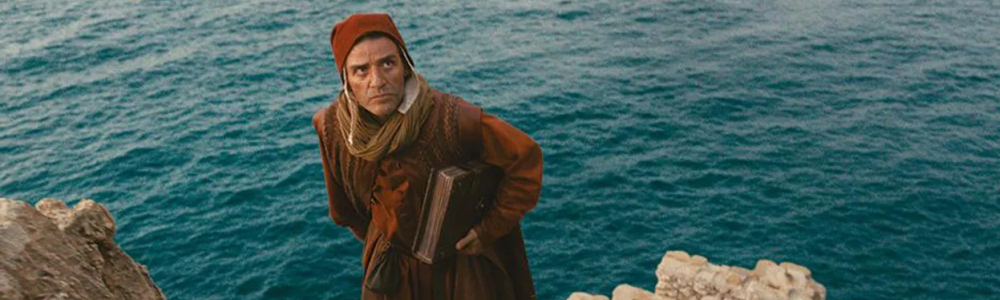
Oscar Isaac plays both Dante Alighieri and a fictionalised Tosches, the hard-drinking literary iconoclast consumed by The Divine Comedy. It sounds like an overly clever conceit. It is. It’s also the film’s masterstroke. The modern story follows Tosches as he’s reluctantly drawn into a Mafia scheme to steal what may be Dante’s original manuscript, throwing a cynical writer into a world of mobsters, collectors, and scholars. It sounds like a Dan Brown airport thriller. Schnabel has stranger ideas.
A celebrated painter long before he became a filmmaker, Schnabel paints with a camera. Like Basquiat, The Diving Bell and the Butterfly and At Eternity’s Gate, this isn’t interested in explaining artists so much as thinking like them.
Isaac’s Tosches is gloriously insufferable, forever quoting Hemingway and Faulkner while curating his own mythology. He claims to know Dante so intimately it almost feels as though he wrote The Divine Comedy himself. His Dante couldn’t be more different: quiet, contemplative and burdened by exile rather than ego. Isaac distinguishes them less through appearance than rhythm until creator and interpreter begin quietly exchanging identities. By the end they feel less like two men than custodians of the same obsession.
That obsession is the film’s real subject. Dante translates revelation into poetry. Tosches translates Dante. Schnabel translates Tosches into cinema. Even the audience becomes another translator, assembling meaning from fragments. In the Hand of Dante isn’t really adapting a novel. It’s attempting to adapt the experience of reading one.
Roman Vasyanov’s cinematography is superb. Medieval Italy glows with ochres, lapis blues and weathered stone while the contemporary story unfolds almost entirely in textured monochrome. The reversal is telling. History isn’t more colourful because it was richer, but because imagination keeps repainting it.
One quietly beautiful sequence encapsulates the film. Over voiceover, Tosches lovingly describes the vivid colours of flowers while the image remains resolutely monochrome. Schnabel trusts imagination to do the colouring in.
The camera rarely settles, gliding through conversations, peering over shoulders and searching every scene for another perspective. Marco Spoletini and Louise Kugelberg’s editing moves just as freely between plot and digression, memory and vision.
Gerard Butler is magnificent as Louie, a bleach-blond mob enforcer whose vocabulary could strip paint. John Malkovich barely raises his voice, playing a Mafia patriarch with the weary efficiency and anonymous striped shirt of a regional franchise manager – albeit one with a proudly ugly Rembrandt self-portrait hanging behind him.
Martin Scorsese’s disguised appearance, heavily bearded and bewigged, feels less like stunt casting than one filmmaker briefly stepping into another’s meditation on faith and creativity. Echoes of Mean Streets are unmistakable, while a trench-coated gunman recalls Travis Bickle. These aren’t quotations so much as reminders that Dante’s questions of guilt, damnation and redemption still haunt American cinema.
However, as the gangster plot recedes and the film loses the productive tension between pulp fiction and high art that made its first half so invigorating.
Gal Gadot never quite convinces, her dual role remaining more symbolic than human. A white-suited Jason Momoa, meanwhile, nudges proceedings into Bond territory, Venice briefly recalling Casino Royale. It’s entertaining, but also revealing. For the first time the film feels as though it’s borrowing rather than inventing.
There’s also something quietly refreshing about the film’s existence. Netflix has spent the last decade handing celebrated auteurs blank cheques, often producing handsome pseudo-prestige curiosities that mistake artistic freedom for discipline. Bardo remains an obvious recent example. In the Hand of Dante occasionally flirts with the same indulgence, but never the same complacency. However overstuffed it becomes, Schnabel remains curious. He keeps asking questions rather than admiring his own answers.
Increasingly, the film recalls later Terry Gilliam, where narrative yields to a filmmaker reflecting on imagination, ageing, and the purpose of art itself. Some will call that self-indulgent. Others will see exhilarating artistic freedom. Both responses are fair.
Like the manuscript at its centre, In the Hand of Dante is less interested in being possessed than in possessing those who encounter it. It never quite comes together, but it lingers. Sometimes that’s the more interesting achievement.