 (3 / 5)
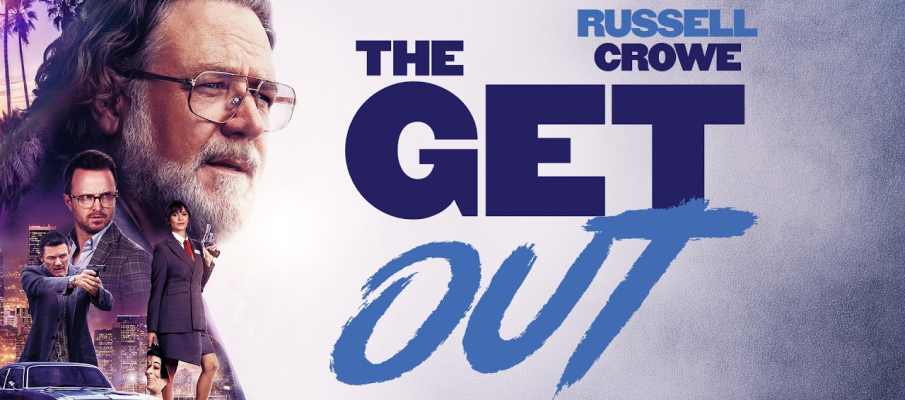
Russell Crowe tries to leave an overcrowded party.
Formerly titled Bear Country, Derrick Borte’s The Get Out arrives with a premise that sounds deceptively simple: a nightclub owner decides he has had enough and decides to get out of the business.
Following a heart attack suffered during an awkwardly memorable bedroom encounter, Manco Kapak (Russell Crowe) begins contemplating an escape route from the life he has built. His younger girlfriend Sunny (Teresa Palmer) dreams of a fresh start in Thailand. For once, the future seems within reach.
Of course, if crime fiction has taught us anything, it’s that nobody gets out that easily.
Adapted from Thomas Perry’s 2010 novel Strip, the film swaps the book’s strip-club milieu for a contemporary Los Angeles nightclub scene, but retains Perry’s fascination with interconnected schemes, desperate amateurs, and escalating consequences. Perry’s novel worked as a sprawling crime caper in which seemingly unrelated players become tangled in increasingly dangerous circumstances. Borte’s adaptation preserves that novelistic structure, for better and worse.
The opening is all atmosphere. A neon title burns across the screen. Club music pulses through halogen-lit streets. Cinematographer Brendan Galvin drenches Los Angeles in blue and pink hues that often feel borrowed from the contemporary action playbook pioneered by John Wick. The city is rendered as a cool, slightly sickly late-night dreamscape populated by hustlers, gangsters, and people who desperately want to be somewhere else.
Russell Crowe leans fully into one of his favourite recent modes: eccentric European tough guy. Sporting a beard, glasses and a thick Albanian accent, he delivers much of the film through a gravelly narration that sounds as though it has been soaked in whisky and cigarette smoke. The performance sometimes threatens to tip into self-parody, yet Crowe remains compelling simply because he still possesses that rugged movie-star charisma. One scene in particular, where Manco calmly talks a desperate person back from catastrophe, reminds you how effortlessly Crowe can command a screen when given material worthy of him.
Around him swirls an increasingly crowded ensemble. Luke Evans has considerable fun as Joe Carver, a potential buyer with shades of Fight Club‘s Tyler Durden, whose easy, offbeat swagger masks murkier intentions.
Aaron Paul, meanwhile, plays Jeff, a downtrodden community-college instructor dragged into criminality through a combination of desperation and blackmail. His anxious energy gives the film some of its strongest comic moments, especially when paired with Nina Dobrev’s unhinged bank teller Carrie, who gradually inserts herself into a scheme she has no business joining.
Much of the humour emerges from these unlikely criminals stumbling through situations for which they are hilariously unprepared. Paul’s tearful panic and Dobrev’s increasingly reckless enthusiasm often prove more engaging than the supposedly central cartel intrigue. In fact, Dobrev ends up feeling like the most fully realised character in the film, a sharp contrast to several underdeveloped players orbiting the main plot.
That imbalance points to the film’s biggest problem. Like Perry’s novel, The Get Out juggles numerous narrative threads: cartel money laundering, a corrupt LAPD detective (Josh McConville), blackmail, robbery, romance, and retirement dreams. On the page, Perry had room to develop these strands gradually. Condensed into a two-hour movie, they often feel as though they are competing for oxygen.
The result is a thriller that takes a long time to gather momentum before suddenly launching into shockingly brutal violence. Tonally, the film never quite settles. It wants to be a comedic crime caper, a noir thriller, and a bloody action movie simultaneously. At times it recalls Tarantino without embracing his heightened stylisation or comic precision. “Tarantino-adjacent” may be the most accurate description.
Bryan Senti’s score contributes significantly to that uneasy mood. Rather than driving suspense conventionally, it frequently deploys odd, insistent plinking motifs that make scenes feel subtly off-balance.
Borte, whose previous credits include The Joneses, American Dreamer, and the enjoyably nasty road-rage thriller Unhinged, which also starred Crowe, clearly relishes this world of desperate people making terrible decisions. Yet unlike Unhinged, where the simplicity of the concept sharpened every scene, The Get Out often feels overstuffed.
The stakes escalate dramatically and sometimes arbitrarily. Characters with obvious solutions to their problems stubbornly ignore them. One repeatedly wonders why Manco, a man wealthy enough to contemplate international retirement, does not simply hire competent security.
Still, there is enough here to keep the film afloat. The performances are committed. The nocturnal Los Angeles atmosphere is consistently appealing. Crowe remains an engaging screen presence even when the material strains credibility. And Perry’s underlying plot machinery retains enough momentum to carry viewers through occasional lapses in logic.
Like its protagonist, The Get Out seems torn between two identities. One is a quirky crime comedy about ordinary people stumbling into extraordinary trouble. The other is a hard-edged thriller about violence, corruption, and the impossibility of escaping one’s past. Neither version fully wins the struggle. The film remains caught somewhere in between: watchable, intermittently entertaining, but never quite able to find the groove it is searching for.
