Michael Sarnoski’s The Death of Robin Hood is the latest attempt to reinvent England’s most enduring outlaw.
We’ve had the iconic swashbuckler, the historical epic, the gritty origin story. Ridley Scott’s Robin Hood and Otto Bathurst’s version with Taron Egerton at least preserved the sense that beneath the grime remained a fundamentally heroic figure. Sarnoski goes further.
His Robin insists the legend itself is a lie. He did not rob the rich to help the poor. He robbed because he enjoyed robbing, and killed because he enjoyed killing.
It’s an intriguing premise: What if Robin Hood wasn’t a folk hero but the sort of violent man history accidentally sanctified? What if eight centuries of ballads had obscured someone far uglier? The film is less interested in Robin Hood as a character than in the process by which memory hardens into myth, each retelling sanding away another bloodstain until murder becomes folklore.
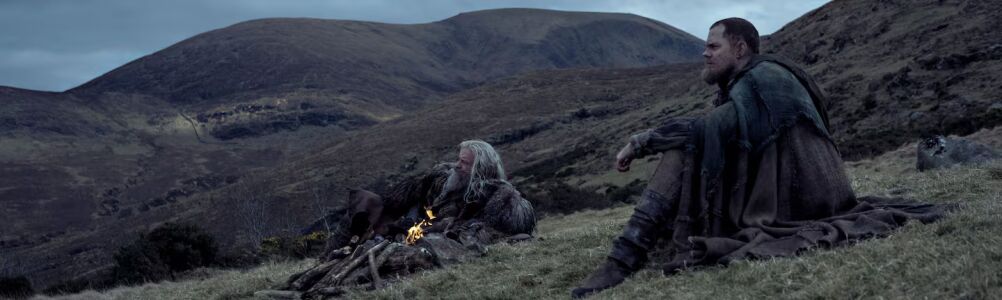
The opening act is relentlessly bleak. Sarnoski drops us into 1247, a world seemingly locked in perpetual winter, where people claw berries from dying trees simply to survive. Robin, played by Hugh Jackman with long grey hair, a weather-beaten face and a broad northern accent, resembles an ageing wolf more than a legendary outlaw. This Robin is less interested in redemption than release, a hulking man who has lived long enough to become weary of his own legend.
As in Pig, Sarnoski is fascinated by men who have become myths in their own lifetimes. There, Nicolas Cage’s Robin Feld was once a legendary chef; Jackman’s Robin Hood an outlaw immortalised in song. Both retreat from the identities that made them famous, only to discover the world refuses to let legends disappear. There are echoes of Logan too: another ageing warrior searching, perhaps too late, for some fragment of peace.
The violence is among the most brutal ever committed to a Robin Hood adaptation. Sarnoski shoots combat not as spectacle but as blind panic. Men crawl through mud, stabbing opponents a dozen times in grief and fury. Children die. One grotesque image of a child trudging home with an arrow protruding from their skull lingers long after the credits. There is no exhilaration here, only attrition.
Bill Skarsgård’s Little John reinforces the film’s central concern with inherited violence. Nobody seems capable of escaping it. Revenge passes from parent to child until killing becomes tradition rather than choice. “It’s a curse,” one character observes, and the film increasingly suggests that Robin Hood’s greatest legacy is not heroism but the generations of bloodshed left in his wake.
Michał Dymek’s cinematography certainly creates atmosphere, but it too often mistakes obscurity for immersion. Much of the first half unfolds at the very edge of visibility, campfires reduced to tiny islands of orange swallowed by mist and darkness. The rugged Irish landscapes evoke Game of Thrones at its bleakest, but there were moments I found myself admiring the mood more than the image. Thank goodness Hugh Jackman and Jodie Comer have cheekbones capable of reflecting whatever light was available.
Curiously, the film becomes more affecting once it slows down.
Robin’s arrival at a remote priory transforms its visual language. Mud gives way to pale stone. Darkness yields to sea air and soft daylight. An orchard, children, and the rhythm of ordinary life suggest a fragile civilisation existing just beyond endless violence. Jodie Comer gives Brigid a contemplative calm rather than saintliness, her striking blue robes recalling Renaissance paintings, a rare splash of colour in a world almost entirely drained of it. She isn’t presented as Robin’s salvation so much as an alternative path: proof that a violent past need not determine the rest of a life.
Jim Ghedi’s score quietly reinforces the film’s central ideas. Eschewing the rousing orchestral sweep traditionally associated with Robin Hood, it instead draws on plaintive strings, sparse folk instrumentation, and mournful melodies that seem to emerge from the landscape itself. Traditional ballads drift through the soundtrack, reminding us that stories are how history survives.
Yet stories also distort. Memory blurs with myth. Every retelling edits reality a little further until people become symbols rather than human beings. By the end, the music has become part of the film’s argument: Robin Hood lives on not because of the man he was, but because of the songs people chose to sing.
Yet I’m still unsure the film’s central argument entirely convinces.
Revisionist westerns such as Unforgiven dismantle myths while ultimately explaining why those myths mattered in the first place. Sarnoski strips Robin Hood back to an ageing killer and asks us to find transcendence there. Jackman almost gets us across the line through sheer force of performance, but the script never quite answers the question it poses. When you remove myth and romance from Robin Hood, what exactly remains?
Sarnoski’s answer is an old man haunted by the lives he destroyed. Mine is that perhaps this isn’t enough. There is a quiet irony in Sarnoski using Robin Hood’s Death, one of the very ballads that helped immortalise the outlaw, as the basis for a screenplay arguing that the legend itself is a lie. Robin Hood has survived for eight centuries because he became something larger than the man history may or may not remember. Strip that mythology away and the film becomes an impeccably crafted elegy, but one that never quite explains why this needed to be a Robin Hood story in the first place.
Still, Jackman gives one of his finest late-career performances, stripping away every trace of movie-star glamour. Comer is quietly magnetic. Dymek’s imagery is haunting. Sarnoski creates a medieval England that feels genuinely ancient, cold, and unforgiving rather than romantically picturesque. Few Robin Hood adaptations have looked this striking (when you can see it).
The Death of Robin Hood is ultimately less an adventure than an elegy. It asks whether legends comfort us because they tell the truth, or because they spare us from it. I’m just not entirely convinced that Robin Hood is the legend that benefits most from such uncompromising demythologising.
Sometimes, after all the deconstruction is finished, you simply miss Errol Flynn.
