 (4.5 / 5)
Wild Horse Nine is a film in which almost everyone seems to be in a foul mood, and for much of its first half, so was I.
Martin McDonagh’s latest follows two fractious CIA operatives, Chris (John Malkovich) and Lee (Sam Rockwell), dispatched to Easter Island against the backdrop of the impending 1973 Chilean coup. They spend an extraordinary amount of time irritating one another and, increasingly, me. Their exchanges are frequently hilarious, sometimes exhausting, and occasionally seem designed to test just how long we can endure the company of two thoroughly cantankerous men. At times, I wondered whether McDonagh had mistaken relentless antagonism for compelling characterisation.
There are obvious echoes of In Bruges: two professional killers, an incongruously beautiful location, questions of loyalty and mortality, and the uneasy possibility of redemption. There’s even a scene recalling its deeply uncomfortable restaurant encounter. Yet Wild Horse Nine feels angrier, sadder and, in some respects, more ambitious. Its protagonists are not merely criminals but instruments of American foreign policy, men who have knowingly and willingly helped undermine democracies across the globe.
Malkovich is extraordinary as Chris, a terminally ill, increasingly forgetful operative whose disillusionment has curdled into something approaching nihilism. His growing volatility and indiscretion, particularly concerning his possible involvement in the assassination of John F. Kennedy, alarm his superiors. His CIA handler, MJ (a wonderfully unpleasant Steve Buscemi), becomes increasingly anxious about what Chris might reveal.
Rockwell provides an excellent counterweight to Malkovich’s extravagance. His fraught telephone conversations with his estranged, alcoholic wife, Marge (Parker Posey), reveal a tenderness beneath the mutual recriminations. For all Lee’s brutality and cynicism, he remains capable of love, however imperfectly expressed.
More devastating is Chris’s developing relationship with Monica (Mariana di Girolamo), an idealistic young Chilean student whom he initially takes considerable pleasure in antagonising. His contempt for her political convictions gradually gives way to something resembling affection, even protectiveness. In one extraordinary scene, he reveals what awaits her country: the overthrow of its democratically elected socialist president, Salvador Allende, the repression that will follow, and the terrible fate of those who resist.
The cruelty of the revelation is compounded by its futility. Chris knows what is coming because he works for the organisation responsible for bringing it about. Yet neither he nor Lee, despite their experience and capacity for violence, can stop the machinery they have helped set in motion. Men who have exercised extraordinary power over strangers suddenly find themselves powerless to change anything that matters. Their impotence does not absolve them of their complicity.
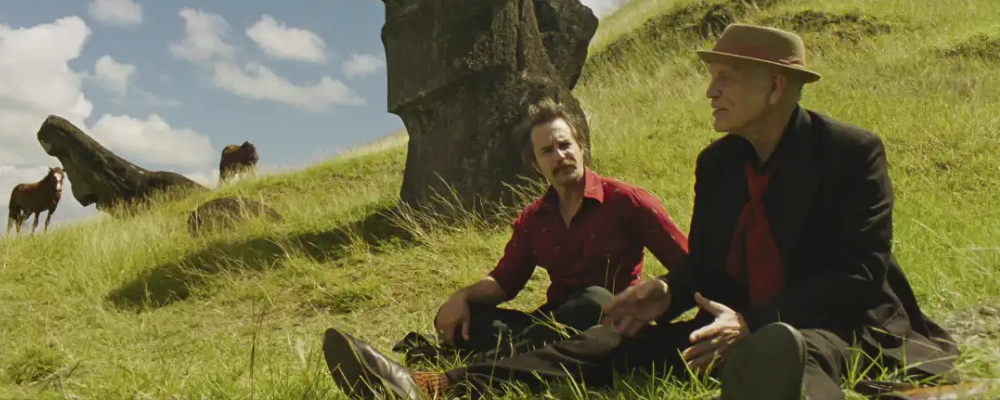
The film’s visual and musical sensibilities contribute enormously to its emotional power. Ben Davis’s cinematography renders Easter Island, or Rapa Nui, a place of almost mythic beauty: rolling green hills, banks of mist, ancient stone figures and wild horses moving through a landscape seemingly indifferent to human affairs. There is something unexpectedly reminiscent of the Ireland depicted in The Banshees of Inisherin, despite the geographical distance. Some compositions feel instantly iconic, dwarfing these petty, violent men against an immense and apparently timeless world.
Carter Burwell’s elegiac score lends proceedings an emotional grandeur the characters themselves seem incapable of expressing. The music, landscape, and recurring animal imagery suggest a world of innocence and beauty beyond the cruelty of human affairs.
For all its considerable virtues, the film remains frequently aggravating. McDonagh’s dialogue occasionally becomes too pleased with its own cleverness, and the relentless hostility can feel repetitive rather than revealing. He is also, perhaps understandably, more interested in the perpetrators of political violence than its victims. A film centred on the Chileans whose lives were devastated by the coup would be an entirely different work, and not necessarily one McDonagh is best placed to make. But his chosen perspective raises an uncomfortable question: does inviting us to empathise with these men also encourage us to forgive them?
Understanding is not absolution, yet cinema can make the distinction dangerously easy to blur. Monica’s plight provides a necessary counterweight, although her suffering also serves to illuminate Chris’s conscience. McDonagh never entirely resolves this ethical tension, and perhaps his achievement is that he makes us confront it.
The magnificent final act brings these contradictions into devastating focus. The mounting tensions between friendship and duty, institutional loyalty and individual conscience culminate in a conclusion that is both brutal and tender. The apparently aimless quarrels, bitter observations, and eccentric digressions acquire an unexpected poignancy. Beneath the bluster lies a terrible sadness: lives squandered, relationships damaged, atrocities committed, and the dawning recognition that there may be no opportunity to put any of it right.
Crucially, McDonagh offers no straightforward redemption. Chris’s regret cannot undo his crimes, nor can his affection for Monica protect her from the consequences of them. But terrible people remain capable of tenderness, and recognising their humanity need not excuse their actions.
What initially felt like an endurance test gradually becomes a remarkably affecting meditation on guilt, friendship, mortality, and the possibility of grace. The characters do not become more agreeable. Instead, their humanity emerges through the very qualities that initially made them so difficult to tolerate.
Wild Horse Nine is savagely funny, deeply melancholy, frequently infuriating and ultimately magnificent. Its images linger, its dialogue gets under the skin, and its emotional force accumulates almost imperceptibly until the final scenes.
I spent much of the film wanting these people to shut up. By the end, I was desperately sorry to leave them.
I’m still not entirely sure I like it.
In fact, I kind of hate it.
It might be one of Martin McDonagh’s best films.
