The verdict is in. So what now?
 (3 / 5)
Before my screening of The Social Reckoning, the Molly Rose Foundation ran an advertisement in which Ian Russell described Instagram’s part in his teenage daughter’s death. It may be unfair to measure a two-hour drama against thirty seconds of a bereaved father’s testimony, but for all the film’s outraged speeches, none lands quite so hard.
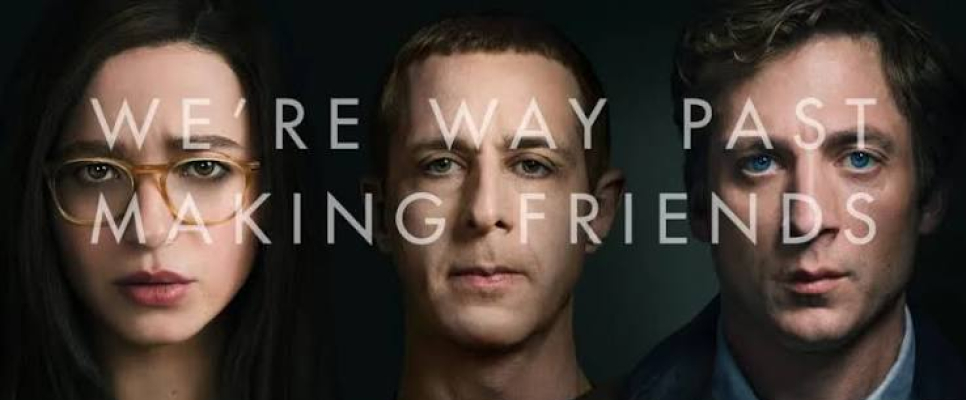
Writer-director Aaron Sorkin opens with a woman hurling racist abuse at police officers trying to help her, then posting the footage on Facebook. Frances Haugen (Mikey Madison), an employee who once knew her, wonders what transformed her and how much Facebook is to blame. Meanwhile, Wall Street Journal reporter Jeff Horwitz (Jeremy Allen White) investigates the gulf between the platform’s public assurances and its private determination to protect engagement at any cost.
Madison anchors the film, making Haugen’s disillusionment credible without softening her intelligence or prickliness: this is a woman who still believes in what Facebook could be. White’s Horwitz, technologically befuddled and besotted with old Hollywood musicals, is less a portrait of the real journalist than a Sorkin surrogate Their growing trust, as Haugen slowly opens up to Horwitz, is the film’s most persuasive relationship.
Their clandestine meetings evoke All the President’s Men, but the tension is muted. We know how Watergate ended too; the difficulty is that Haugen’s private life is too lightly sketched for us to feel what her decision costs. We admire her courage without sharing her apprehension.
Jeremy Strong plays Mark Zuckerberg with clipped speech and a fixed gaze. Wunmi Mosaku’s exasperated crisis manager gets a genuinely funny scene teaching him to behave like a human being, and Bill Burr, as a fictional former investor turned critic, brings earthy fury to sessions that expose how quickly Zuckerberg’s talk of free speech and the public square yields to engagement.
Where Jesse Eisenberg’s Zuckerberg in David Fincher’s The Social Network was brittle, conceited and occasionally pitiable, Strong offers a seamless surface: less a man dehumanised by power than one who never seemed human to begin with.
The deeper problem is that Sorkin explains Facebook’s damage better than he dramatises it. Arriving five years after the revelations it depicts, the film tells us what we already know: outrage drives interaction, interaction drives advertising, advertising drives growth. His volley of interruptions and cutting rejoinders remains a pleasure, but the arguments are rarely complex enough to surprise, and Betty Gilpin’s brisk editor and Billy Magnussen’s cheerfully amoral manager function largely as positions within them. Radicalisation, teenage suffering, and democratic erosion are described rather than made tangible.
The filmmaking does little to help. It’s handsomely mounted, from an ambitious opening tracking shot to elaborate titles, but conventional. Jeff Cronenweth, who also shot The Social Network, finds little atmosphere in the corporate interiors; Alan Baumgarten’s editing keeps things moving without building tension; and Alexandre Desplat’s score supplies emphasis the scenes scarcely need. Setting Renée Fleming’s wordless soprano against the violence of January 6 lends an almost sacred solemnity to images whose horror is self-evident.
Fincher’s film, aided by Cronenweth’s shadowy photography and Trent Reznor and Atticus Ross’s score, gave Sorkin’s dialogue an unease beyond the words, and gave Zuckerberg’s ambition a comprehensible cost: he ended alone, refreshing an unanswered friend request.
That film’s closing cards boasted 500 million users and a $25 billion valuation. By the time of The Social Reckoning, Facebook had 2.8 billion users and a trillion-dollar valuation, and Zuckerberg had become a political actor, his control of Meta shielding him from shareholders while those affected by his decisions had no comparable say. The ambition that cost him a friend now affects billions, but harm so dispersed is hard to contain within a human story. The intimate drama has become vastly more consequential, and far less involving.
My objection is not that Sorkin is wrong; there is no moral ambiguity to invent. But being right is not the same as being dramatic, and the scale of the wrongdoing cannot supply dramatic weight on its own.
Armando Iannucci has observed that satire can no longer keep pace with reality. Perhaps drama faces the same problem. When the world is already this unsubtle, an unsubtle, if far from unintelligent, film may simply be following the course of events.
The ending makes this plain. Haugen delivers a stirring statement before Congress, the kind of morally lucid speech on which Sorkin has built his career. Yet his own postscript concedes that Meta later abandoned third-party fact-checking in the United States. Watergate brought down a president; here the evidence is published, the speeches are delivered, and Facebook carries on.
Sorkin’s faith that exposure might be enough is admirable but, in a 2026 film about revelations from 2021, strangely nostalgic. It worked for Mr Smith when he went to Washington. What good does it do now?
For all its wit, performances and conviction, The Social Reckoning cannot deliver what its title promises. A more troubling film might have made the failure of accountability its subject. Instead, Sorkin builds towards a triumph history has already undermined. The evidence has been gathered, the verdict delivered, and Zuckerberg is still in charge.
