WARNING: Some spoilers for a 3,000-year-old epic poem
Christopher Nolan has spent much of his career telling stories about men trying to find their way home.
Cobb in Inception, Cooper in Interstellar, even Oppenheimer, in a moral rather than geographical sense, are all attempting to return to something they have lost: family, certainty, themselves. Nolan himself recently acknowledged as much, describing The Odyssey as “a very strong foundational text” and admitting, “I’ve been telling this story in all my films for years.”
If Oppenheimer was Nolan’s historical epic, The Odyssey is his mythic one. Like Homer’s poem, it sprawls across continents, kingdoms, and decades, balancing an enormous ensemble without ever losing sight of the solitary figure at its centre. Yet, as with Oppenheimer, the conquest itself is almost incidental. Troy matters less than what it leaves behind. This is a film about victory’s psychological afterlife.
Matt Damon gives Odysseus a weary gravity. This is not stoicism as philosophy but as necessity: a man who has witnessed too much, committed too much, and long since abandoned the luxury of emotional display. Guilt and grief constantly threaten to break through the armour, making survival itself feel like another burden he has accepted rather than escaped.
The shadow of Kubrick has long hung over Nolan’s work, though never in a way that feels imitative. Rather, each film seems to pair Kubrick’s formal precision with another cinematic sensibility. Interstellar married his cosmic grandeur to Spielberg’s emotional wonder; The Odyssey broadens the palette once again. Alongside Kubrick’s monumental compositions and Spielberg’s gift for awe, Nolan occasionally ventures into stranger territory.
For yes, here be monsters. Yet they are not polished digital abstractions but uncanny physical presences.
The Cyclops is a remarkable creation, a 60-foot mechanical animatronic puppet brought to life by creature and effects specialist Adam Wright, somewhere between a Ray Harryhausen creation made flesh and a Terry Gilliam fever dream, yet possessing the unsettling quality of something that still lurks in the liminal spaces of The Backrooms.
The film’s wider treatment of myth also recalls Guillermo del Toro, presenting fantastical beings not as escapist spectacle but as ancient creatures inhabiting the same physical world as its human characters.
Circe’s transformation of men into swine is equally striking, their faces stretching and reforming with echoes of Rick Baker’s An American Werewolf in London, filtered through the folkloric nightmare of The Company of Wolves. Throughout, the effects favour texture, weight and imperfection over digital polish, making mythology feel less like fantasy than forgotten history.
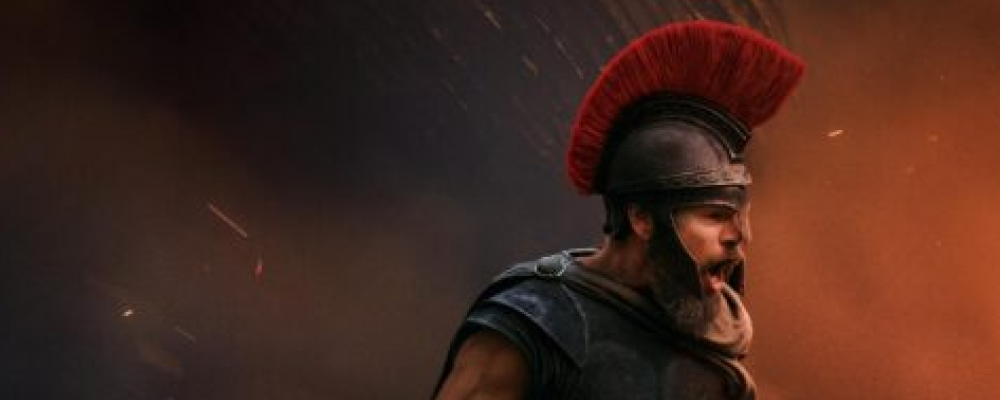
That physicality extends beyond the creatures. Nolan insists that myth occupy the real world. The Trojan Horse is not triumphantly wheeled into place but hauled laboriously across the earth by exhausted soldiers. Ships splinter rather than explode. Weapons wound with sickening force. Even the surprisingly light armour feels purposeful, designed not for heroic poses but for men constantly running, climbing, rowing, and fighting. Myth survives, but acquires dirt beneath its fingernails.
With Hoyte van Hoytema’s cinematography, antiquity feels neither picturesque nor remote but startlingly immediate, every frame shaped by salt, smoke and sun. Weathered colours give the world the texture of somewhere lived in rather than reconstructed, while deep blacks frequently cast entire landscapes into immutable shadow.
The opening shoreline inevitably recalls Dunkirk, not because it resembles that film visually, but because it evokes the same overwhelming sense of distance. Home exists first as an idea rather than a destination, always lying beyond one more horizon. The sea offers no passage, only another trial, its storms and currents seemingly determined to prolong every journey. Few contemporary filmmakers capture nature as something both breathtakingly beautiful and utterly indifferent to human suffering.
Nolan has often built his films around abstract ideas that become navigational stars. In Interstellar, love transcends dimensions. Here, love becomes something more demanding: sacrifice. Anne Hathaway’s Penelope is not simply the faithful wife waiting at home but the moral destination against which every compromise is measured. Before Odysseus can return home, he must first become worthy of it.
If the gods rarely appear as physical beings, they nevertheless govern every frame. Monsters unquestionably exist, yet divine intervention remains tantalisingly ambiguous, leaving characters suspended between fate and chance. Is Odysseus genuinely cursed, or simply catastrophically unlucky? Nolan resists definitive answers, allowing myth and psychology to coexist without either diminishing the other.
The film repeatedly returns to civilisation’s most fragile foundation: hospitality. Zeus’ sacred law, the obligation to welcome strangers while respecting the homes of others, has collapsed. For all its monsters and miracles, Homer’s epic suggests civilisation is defined less by how we wage war than by how we treat those who arrive at our door.
Every land Odysseus reaches becomes another variation on that failure. His crew arrive as unwelcome intruders; the Cyclops devours them; the giant, silver-armoured Laestrygonians butcher them without hesitation; Circe strips them of their humanity; Charlize Theron’s Calypso offers comfort so sincere it becomes difficult to distinguish compassion from possession; and the suitors consume another man’s household from within.
Against them all stands Anne Hathaway’s grief-stricken Penelope, patiently preserving the possibility that home might still mean sanctuary rather than territory to be conquered.
Jon Bernthal’s Menelaus carries himself with the blunt physicality of someone permanently shaped by war, while Lupita Nyong’o lends the reclaimed Helen of Troy a quiet bitter melancholy that resists reducing her to either prize or temptress.
Tom Holland brings Telemachus a convincing mixture of nobility and youthful uncertainty, while John Leguizamo steals every scene as the blind, irascible yet fiercely loyal swineherd. Robert Pattinson offers the film’s resident Wormtongue; all squirmy charm, insinuation, and smiling self-interest. Even the occasional modern inflection in the dialogue feels deliberate, subtly collapsing the distance between epic and everyday.
The final movement, exhilaratingly staged with Odysseus first rediscovering his bow before improvising with an ever-expanding arsenal of whatever lies to hand, becomes improbably part Greek tragedy, part John Wick. Each increasingly audacious feat carries him further into legend without severing him from his humanity. Even at its most operatic, the violence never loses its physical consequence. Limbs break, arrows thud, bodies fall with exhausting finality. Like the greatest myths, it enlarges its hero into something almost superhuman while never allowing us to forget the wounded man beneath the legend.
Ludwig Göransson’s score is comparatively restrained by Nolan’s standards, favouring mournful texture over relentless propulsion. Nolan approaches Homer’s poem less as sacred text than living story, seeking to restore the uncertainty, terror, and wonder it must once have carried for its earliest audiences.
Structurally, The Odyssey is unexpectedly restrained. Nolan plays with chronology just enough to mirror memory’s fractured nature, but never allows formal experimentation to eclipse emotional clarity. Time, his perennial obsession, becomes less a narrative device than an emotional burden. Every reunion is haunted by everything that can never be recovered.
The film’s episodic form inevitably means some encounters resonate more deeply than others, and not every stage of Odysseus’ journey carries the same dramatic weight. Yet Nolan gives each episode its own distinct visual identity, ensuring the succession of trials never settles into repetition.
In some respects, this is one of his least “Nolan” films. Rather than constructing another cinematic puzzle box, he largely sets aside the intricate structural conceits that have distinguished films from Memento and Inception to Dunkirk and even the divisive Tenet, trusting the oldest surviving adventure story in Western literature to generate its own momentum.
What The Odyssey never quite achieves is the overwhelming emotional catharsis of Nolan at his very best. That is less a criticism of this film than a recognition of the extraordinary standard against which it must inevitably be judged. Nolan has reached the point, like Kubrick before him, where each major work inevitably enters into conversation with the rest of his canon.
Damon gives Odysseus enormous moral weight, yet Nolan remains, by instinct, more fascinated by ideas than emotional intimacy. We understand the cost of Odysseus’ journey more readily than we feel it.
Nolan’s greatest works, from Memento and The Prestige to Interstellar and Oppenheimer, occasionally transcend their conceptual brilliance to become emotionally overwhelming. The Odyssey reaches for that same summit and comes tantalisingly close. For material operating on the scale of myth, its reserve is often appropriate, perhaps even necessary, but it leaves the film just shy of true transcendence.
By the closing moments, The Odyssey becomes something more than another prestige adaptation. Like Homer’s poem itself, it is ultimately less concerned with monsters than with the man who survives them. It asks whether home can still exist after war, whether identity can endure years of violence, and whether civilisation rests on something as fragile as the simple act of welcoming a stranger. In doing so, it restores myth to something living, revealing Homer’s epic not as a distant relic but as an enduring meditation on war, memory and belonging.
For Nolan, home has never been merely a destination. It is something continually earned, continually threatened, and perhaps never fully recovered. That has been the hidden current running beneath his cinema all along, and here, at last, it returns to its source.
